Tuesday, October 29, 2019

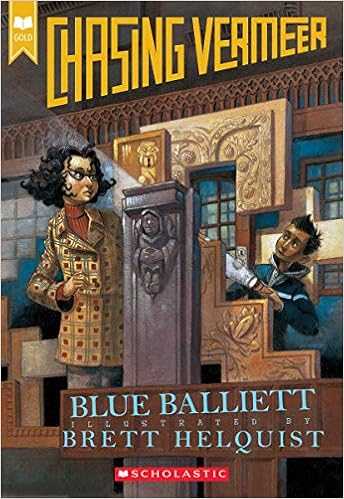
Chasing Vermeer

"Do not be afraid to go against what you were taught, or what you were told to see or believe. Every person, every set of eyes, has the right to the truth" (Balliett 2004)

I've officially read my favorite book of the challenge so far. "Chasing Vermeer" was unlike any of the books I have read this far, and it definitely made a lasting impression on me. This book would be an excellent inclusion for a classroom for upper elementary students. It incorporates all different subjects, such as art, history, math, and science.

The mystery takes place in Chicago near the University of Chicago. Two best friends, Calder and Petra, become mixed up in a town scandal when a painting by Johannes Vermeer is stolen while on the way to the Art Institute. Using articles in the newspaper, the thief tells the city that they will return the painting if someone cracks his code. The community must figure out which of Vermeer's paintings were actually done by him. Calder and Petra accept the task and look for the painting using various clues.

Throughout the book, there are several codes that the reader must solve while reading. These codes involve pentominoes and frogs hidden in the illustrations. The readers can count the number of hidden frogs in every other illustration, as well as find the hidden pentomino. Each pentomino corresponds to a letter. The letter and the number of frogs can be used to decode a secret message.

This book is so interactive and incorporates many different subjects. I can see this book being used in a 3rd to a 5th-grade classroom in a math unit. Pentominoes are a fun math manipulative that students love to use. Incorporating them into decoding messages is a fun way to make the book come to life for the students. This book can also be used for a history or art lesson. It discusses different artists and painting styles, as well as the history behind them. 

 This book has 3 sequels, and I definitely plan to read these next. I hope they are just as fun as this one. If you're looking for your next book to read, I definitely recommend this one!

Tuesday, October 15, 2019

Hey, Kiddo

“Stories keep memories alive and people real to us" (Krosoczka).


A few more books down this week! I read a few Judy Moody and Goosebump type books, just for fun. I loved these kinds of books growing up, so it was good to go back to my childhood a little. One book I read was Hey, Kiddo. This graphic novel sent me on a rollercoaster of emotions I definitely was not prepared for.

Growing up, Jarrett had anything but a normal, happy childhood. Early on in his life, his mother kept getting into trouble, whether it was for shoplifting or with bad guys. His father was not in the picture at all, either. Because of this, Jarrett goes to live with his grandparents. His mother is in and out of his life, and Jarrett grows unattached to her. He finds out that she is a drug addict and has landed herself in jail. All while this is happening, Jarrett begins to love drawing and comics. His grandparents are dealing with their own issues as well, such as drinking and gambling. As the story goes on, readers can see Jarrett grow from a child to a teen with a passion who is graduating high school. There are so many twists and details I don't want to give away, so I'll stop there.

This book deals with tough issues, such as addiction, growing up, and absent parents. Every reader can find something they relate to within this book, whether it be a character, emotion, or situation. Introducing this book to students of older age, such as high schoolers, could truly impact their lives. You can never truly know what is going on in a student's life, so this book could act as a lifeline to students. It shows that they are not alone, and other people go through the same trauma as they do. The ending of the book, for me, was the most emotional. As Jarrett is graduating, he comes to realize that family is who you make it. He expresses his love and gratitude for his grandparents, who have always been there for him. He finds his dad and his half-siblings and develops a relationship with them. it just shows that no matter what you go through, you will always have people who love you.

Well, that's it for this week! I can almost see the finish line of books! Tune in next week to see what I read next!

Tuesday, October 8, 2019

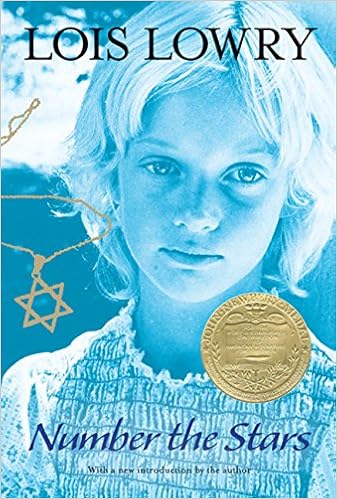
Number the Stars

“The whole world had changed. Only the fairy tales remained the same" (pg. 47)


I remember reading this book in 3rd, maybe 4th grade. It was a required book, so I didn't take it very seriously. I only read the assigned chapters, completed the worksheets, and took the tests. Rereading this book later in my life really threw me for a loop. This book deals with a real-life tragedy that some children, like myself, may not understand.

Annemarie and her family live in Copenhagen in the midst of Nazi occupation in Demark. She and her best friend, Ellen, live in a large apartment building. They have their first encounter with German soldiers on their way home from school, and the interaction leaves them both unsettled. This is because Ellen and her family are Jewish. As time moves on, they begin to notice more and more things in their neighborhood are changing. It begins with Jewish shops closing. Then, Ellen's family is forced to flee, leaving Ellen in the care of Annemarie's family. The family travels to an uncle's home, where Ellen is reunited with her family. That night, the uncle manages to hide Ellen's family in a boat, which allows them to travel safely to Sweden, which is a safe spot for the Jewish family. By the end of the book, the war ends, and Annemarie awaits her best friend's return.

This book is a great look into World War II through the eyes of a young girl who can be relatable to the young readers for whom this book was written. The child-like writing and narration make you feel like you are Annemarie, living out the story that is told. This can get readers more involved in the story, which can help their critical thinking. They begin to wonder what it would be like if they really did live during the events.

Along with the writing, the book does a great job of teaching tough topics. Aside from the overarching Nazi/war conflict, there are a few dark themes that arise. The most prominent is loss. Early on in the book, it is mentioned that Lise, Annemarie's older sister, is dead. Annemarie believes she died in an accident years ago. She was engaged to marry Peter, an outgoing and fun man. However, towards the end of the book, Peter is killed by the Germans because he was a member of the Resistance. Annemarie's parents reveal that Lise was also a member of the Resistance, and she too was killed by German soldiers. This is not the only kind of loss included in the story. Annemarie has to watch her best friend's parents flee, then has to watch her friend leave as well. This topic comes into life more than we'd like, and this book gives great insight into the topic.

The ending, in my opinion, was great. It is never revealed if Ellen's family made it to Sweden safely or if they'll return to the neighborhood. This leaves readers wondering about the family, and they can even come up with their own resolution. I love endings like this because it keeps everyone guessing. 

Almost halfway to my goal of 20! Stay tuned for next week's book!

Tuesday, October 1, 2019

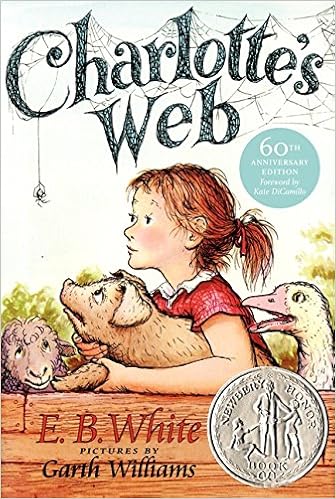
Charlotte's Web

"All these sights and sounds and smells will be yours to enjoy, Wilbur - this lovely world, these precious days..." (pg. 164).


This week, I read a few books. I read The Boxcar Children by Gertrude Chandler Warner and The Haunted Mask by R.L. Stine. These books were very enjoyable to read but did not hold any deeper messages to discuss. I also read the classic Charlotte's Web by E.B. White, which is the topic of this week's review!

This book begins with the birth of a litter of pigs, with one of them being a runt. Instead of killing him, Fern's father allows her to raise the pig on a bottle. She does this for a while, but Wilbur gets too big to keep at their house. She sells the pig to her uncle who lives down the road. Fern visits Wilbur and his new farm friends every day. One day, Wilbur learns he may be killed for food. Fearful for his life, he turns to Charlotte, who is a spider. She assures him that she will solve the problem. She decides to make Wilbur look like a show pig by weaving positive words about him into her web. The farmer buys into this and takes Wilbur to the fair. He wins the show, but sadly, Charlotte is too weak to come home with them. Wilbur takes her egg sac back to the farm, where Charlotte's babies hatch.

I remember reading this book as a young child and weeping over the death of Charlotte. This book was probably by first insight into the circle of life, and it will forever hold a spot in my heart. Like my first book, Bridge to Terabithia, this book deals with the topics of friendships and death. In the book, Wilbur has a hard time making friends at first, but he eventually finds his way into some lives. The readers get attached to these friendships and bonds that are made. Sadly, one of the most loved characters dies in the end, and readers are left feeling hopeless like Wilbur. This book, in my opinion, should be introduced into the classroom early on.

So, 5 out of 20 books down! Next week, I plan to review Number the Stars by Lois Lowry. Stay tuned!

The Hunger Games

“You don’t forget the face of the person who was your last hope” (Collins 2008) To finish out the 20 Book Challenge, I decided to end t...